
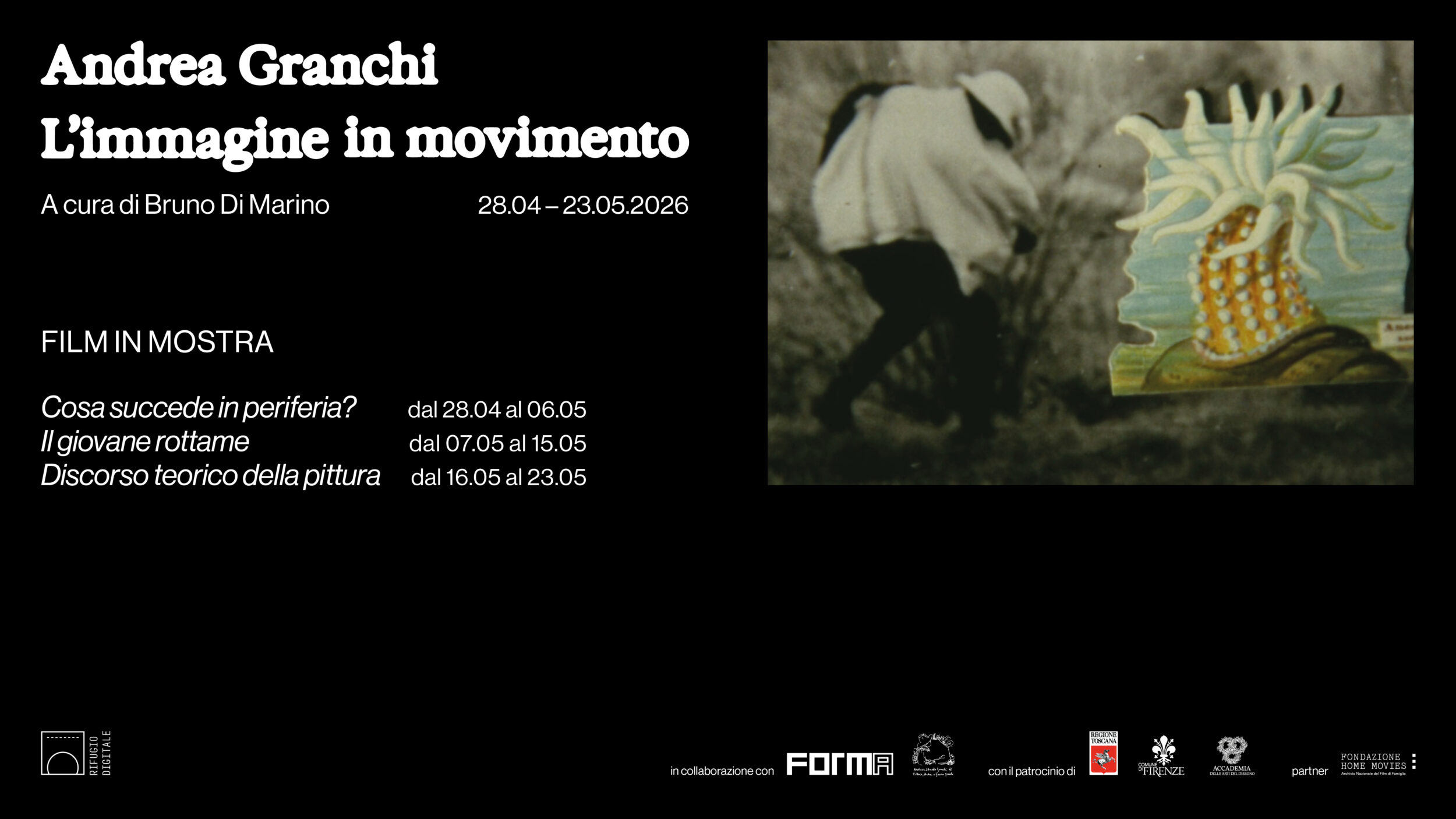
From April 28 to May 23, 2026, Rifugio Digitale presents Andrea Granchi. The Moving Image, curated by Bruno Di Marino: a retrospective dedicated to the Florentine artist and filmmaker Andrea Granchi, among the pioneers of Italian artists’ cinema and an tireless promoter of cultural initiatives, festivals, and programs at both national and international levels. The exhibition opening, on Tuesday, April 28 at 6:30 pm at Rifugio Digitale, will be preceded by a talk from 5:00 pm to 6:00 pm, featuring Bruno Di Marino (Scholar of the moving image), Bruno Corà (Art critic), Laura Andreini (President of the Rifugio Digitale Association), and Giacomo Granchi (Director of the Archivio Studio Granchi).
The exhibition is realized in collaboration with Forma Edizioni and the Archivio Studio Granchi, with the patronage of the Regione Toscana, the Comune di Firenze, and the Accademia delle Arti del Disegno, and in partnership with Fondazione Home Movies.
Andrea Granchi. The Moving Image originates from the homonymous publication published by Forma Edizioni and traces the continuous evolution of visual manipulation, at the core of the artist’s research. The exhibition highlights over fifty years of experimentation through a display that brings together cinematic languages, visual arts, and archival materials.
The itinerary unfolds around three films, presented on a weekly basis:
Cosa succede in periferia? (1971) is one of the artist’s best-known works: a visual “little theater” in constant transformation, constructed through experimental animation techniques, collage, and the manipulation of historical, photographic, and pictorial images, generating a fragmented, ironic, and unpredictable narrative.
Il giovane rottame (1972) addresses, in a paradoxical key, the themes of existence and aging, staging the figure of a young man who progressively loses parts of himself in a sort of reverse career. The film engages in dialogue with photographic series and works on emulsified canvas, highlighting the intermedial nature of Granchi’s research.
Discorso teorico della pittura (1974) “animates” the painter Marletta in his studio through heroic poses, while a voice-over develops a discourse on art and painting. What emerges is a reflection on seriality, repetition, and variation of the image, in a dialogue between cinema and artistic practice.